Bildan Serif Font for Handmade Labels & Invitations
As someone who hand-presses candle labels, designs wedding invites for local brides, and sells printable planner pages on Etsy, I’ve learned that the right serif font doesn’t just look pretty—it builds trust, signals quality, and quietly tells your customer, “This was made with care.” That’s exactly why Bildan has become my go-to display font for projects where elegance and readability must coexist.
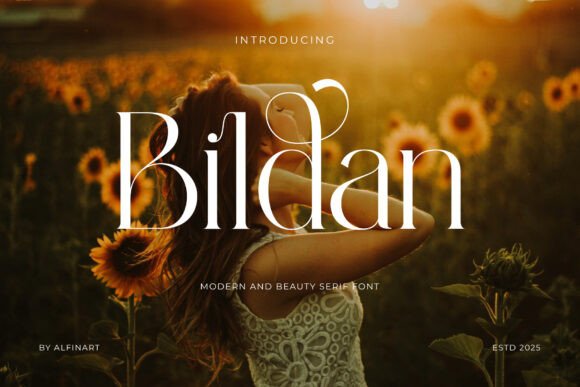
Bildan is a modern serif typeface with delicate floral grace and confident structure. Its ligatures aren’t fussy—they’re bold yet refined, like calligraphed stems meeting clean letterforms. The curves feel organic, not ornamental; the spacing stays open and legible even at small sizes. It’s feminine without being fragile, timeless without feeling dated—perfect for makers who want sophistication that still cuts cleanly on a Cricut or Silhouette.
Where Bildan Shines in Physical Craft Projects
I use Bildan most often where first impressions matter: product labels, boutique tags, greeting cards, and wedding stationery. Its strong x-height and generous counters mean it holds up beautifully on 0.75” sticker sheets, printed kraft tags, and matte-finish invitations. Unlike some decorative serifs that blur or lose definition when scaled down, Bildan keeps its charm—even at 14pt on a lavender-scented soy candle label.
Here’s how it works across real projects:
- Handmade product labels: I pair Bildan for brand names (like “Hearth & Petal Botanicals”) with a clean sans serif for ingredients and weight—creating instant hierarchy and warmth.
- Wedding signage: On acrylic welcome boards or chalkboard-style prints, Bildan’s ligatures add subtle movement—think “Mr. & Mrs. Ellis” flowing as one elegant phrase, not two stiff words.
- Digital printables: For printable wall art (“Bloom Where You’re Planted”) or planner headers, Bildan gives a premium, curated feel without requiring design expertise.
- Seasonal packaging: During spring markets, I use Bildan on pastel mailer boxes and tea towel tags—it reads as fresh and intentional, never generic.
- SVG designs for cut files: Its smooth curves and consistent stroke weight translate reliably to vinyl cutting. No jagged joins, no lost details in the “f” or “&” ligatures.
Readability & Production Notes You’ll Actually Use
Let’s talk practicalities. Yes, Bildan includes stylistic alternates and swashes—but I reserve those for hero text only (e.g., a single “Welcome” on a farmhouse sign). For anything functional—ingredient lists, size charts, QR code captions—I stick to the standard character set. Why? Because clarity trumps flourish when someone’s squinting at a tiny tag in a craft fair booth.
On printed cards, Bildan performs best at 18–28pt for body headings and 36–60pt for titles. At larger sizes, its ligatures truly sing—especially the “Th”, “Fl”, and “St” combinations. But don’t force it into paragraphs. This isn’t a text face. It’s a display font, designed for impact, not endurance.
If you’re prepping files for print-on-demand or local printers, confirm your version includes OpenType features (ligatures auto-enable in Illustrator and Affinity Designer). And always export final PDFs with fonts outlined—no surprises when your lavender soap label arrives with missing glyphs.
Smart Pairings for Balanced Design
One of the reasons Bildan feels so versatile is how well it pairs with other voices. My most-used combos:
- With a warm sans serif (like Montserrat or Poppins): Clean contrast for labels and digital templates. Bildan handles the brand name; the sans carries supporting text—professional, balanced, shelf-ready.
- With a gentle script (like “Lavanderia” or “Maiden Orange”): For wedding suites or boutique gift cards. Let Bildan anchor the layout with structure, while the script adds handwritten intimacy in names or dates.
- With a sturdy mono-spaced font: Unexpected but effective for apothecary-style ingredient lists or minimalist packaging—Bildan for the product title, monospace for the fine print.
Licensing, Formats & What’s Included
The version I purchased includes OTF and TTF files, full multilingual support (including Central European and Romanian characters), and access to all standard ligatures plus discretionary swashes. No extra plugins needed—just install and use in Canva, Cricut Design Space, Silhouette Studio, or Adobe apps.
Crucially, it comes with an extended commercial license. That means I can legally use Bildan in client work, sell SVG files containing it, bundle it in editable Canva templates, and print it on mugs, tote bags, and apparel—all without needing permission for each sale. If you’re selling physical products or digital downloads, verify your license covers your intended use. Not all premium font licenses do.
Why This Serif Feels Like a Quiet Upgrade
There’s a difference between fonts that look beautiful on a mockup and fonts that perform beautifully in the real world—on a sticky label under humid market lights, on a thin vellum invitation that backlights slightly, or on a small ceramic mug where every curve must survive firing and glazing.
Bildan bridges that gap. It’s not trying to be everything. It’s a focused, intentional typeface—designed for moments where your customer pauses, reads slowly, and feels something before they even smell the candle or open the card. In handmade business, that pause is worth more than pixels or points. It’s the quiet signal that what they’re holding was made by someone who cares about both beauty and function—and that’s the kind of detail that turns one-time buyers into repeat customers.