Marshmella: A Classy Sans Serif Typeface for Handmade Creators
It started with a candle label—just a simple soy wax blend named “Honeyed Sage.” I’d sketched the layout on scrap paper, then opened my design software, scrolling through fonts until something clicked. That’s when Marshmella appeared: clean, confident, and quietly elegant. Not too bold, not too thin—just right for a small-batch candle brand that values warmth without sacrificing polish.
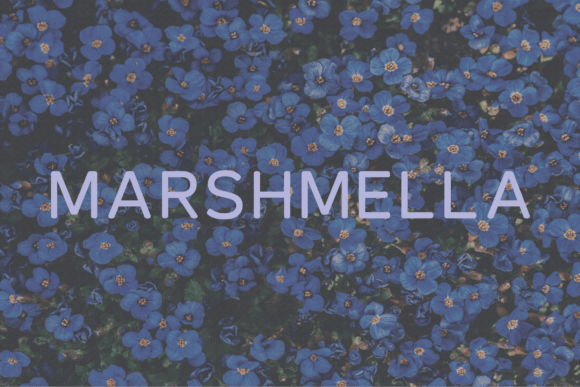
Marshmella is a modern sans serif typeface built for makers who care how their words feel as much as how they look. It’s not flashy or overly stylized—it’s grounded, legible, and effortlessly refined. The uppercase letters have gentle curves and balanced proportions; the numbers 0–9 are clear and consistent; punctuation marks sit just so—not cramped, not loose. There’s a quiet confidence in its spacing and rhythm, like handwriting that’s been carefully practiced until it feels both personal and professional.
I first used Marshmella on a set of kraft paper gift tags for a spring collection. Printed at 12pt on matte cardstock, the font held its shape beautifully—even the tiny ampersands and periods stayed crisp. Later, I scaled it up for a farmhouse-style wooden sign (“Gather Here”) and watched how its clean lines softened just enough against raw wood grain. It’s that rare sans serif font that works equally well at 8pt on a sticker sheet and 72pt on a printable wall art PDF.
For greeting cards, Marshmella shines in titles and short sentiments—“You’re Loved,” “Happy Birthday,” “With Gratitude”—where tone matters as much as typography. Its open letterforms breathe easily on textured paper, and its even weight distribution keeps ink from bleeding on lighter stocks. On wedding invitations, it pairs naturally with a delicate script for names and a sturdy serif for details—no visual competition, just thoughtful contrast. And for digital printables like planner pages or habit trackers? Marshmella’s clarity makes checkboxes, headers, and date fields instantly scannable—even on tablet screens.
When designing product labels—especially for candles, bath salts, or herbal teas—I rely on Marshmella’s readability at small sizes. Unlike some decorative sans serifs that blur or tighten when scaled down, Marshmella maintains generous counters (the open spaces inside letters like ‘a’ and ‘e’) and distinct character shapes. That means your “Lavender + Vanilla” label stays legible on a 1.5-inch sticker, and your “Hand-Poured in Oregon” tag reads cleanly under shop lighting or in natural window light.
Sticker sheets are where Marshmella truly proves its versatility. Whether cut on a Cricut or Silhouette, its clean edges hold up across vinyl, holographic foil, or matte paper. No awkward joins or pixelated corners—just smooth, confident cuts. I’ve used it for seasonal tags (think “Merry & Bright” on red-and-green gift wrap), boutique packaging ribbons, and even minimalist mug decals. The font doesn’t shout—it invites attention with quiet consistency.
For tote bags, t-shirts, and ceramic mugs, Marshmella delivers strong visual impact without overwhelming the item itself. Its moderate x-height and restrained stroke contrast make it ideal for screen printing and heat transfer applications. On a canvas tote, “Good Things Take Time” feels intentional and unhurried. On a ceramic mug, “Brew Well” looks warm and approachable—not sterile or corporate.
Pairing Marshmella thoughtfully deepens your design story. With a soft serif like Lora or Merriweather, it grounds editorial-style packaging or invitation suites. Against a friendly handwritten font, it creates balance—like using Marshmella for a shop name and a script for the tagline. For digital templates or social media graphics, it pairs cleanly with a bolder display sans (think Montserrat Bold or Poppins SemiBold) to create hierarchy without clutter.
Before using Marshmella commercially—whether on physical products, SVG files, or digital downloads—I always double-check the license terms. Most versions include OTF and TTF files, full punctuation, and basic multilingual support (Latin-based languages). Some include stylistic alternates or ligatures—great for adding subtle personality to wedding stationery or boutique signage. If you're designing for international markets or non-English speakers, verify glyph coverage early. And if you're cutting intricate designs, test a few characters first—some weights render more smoothly than others on certain machines.
What sets Marshmella apart isn’t just its appearance—it’s how it supports your creative intention. It doesn’t distract. It doesn’t apologize. It simply presents your words with quiet authority and handmade charm. Whether you're labeling a jar of small-batch jam, designing a printable quote for a nursery wall, or building a cohesive brand identity across Etsy listings and Instagram posts, Marshmella helps your voice land clearly—and kindly.
I keep it in my go-to font folder alongside two or three trusted companions—a warm script for flourishes, a sturdy serif for body text, and Marshmella for everything in between: headlines, tags, titles, signs, labels, and the quiet moments where typography becomes part of the product’s soul.
If you’re choosing a sans serif font for real-making—not just mockups, but actual labels, stickers, cards, and merchandise—Marshmella earns its place not because it’s trendy, but because it’s reliable, expressive, and made for the careful work of hands-on creation.