Trilogi: A Bold, Handcrafted Script Font for Makers
There’s that quiet moment—just before hitting “print”—when you’re staring at a candle label mockup on your screen, wondering if the typeface truly feels like your brand. I was testing Trilogi for a new soy wax line with notes of amber and cedar, and as soon as I typed “slow burn” in Trilogi, everything clicked. Not because it’s perfect—but because it’s alive: smooth curves, relaxed rhythm, and just enough personality to whisper “handmade” without shouting it.
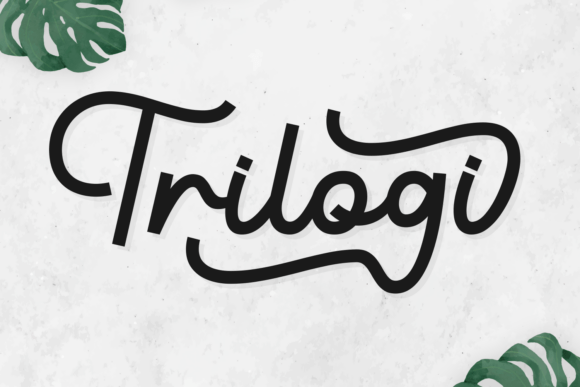
Trilogi is a modern script font from Script Amp, designed with makers in mind. It’s not fussy or overly formal—it leans into its handcrafted roots with gentle swashes, subtle bounce, and a laid-back confidence. Think of it as the kind of handwriting you’d use to sign a thank-you note tucked inside a gift box: intentional, warm, and quietly expressive. It’s a display font first and foremost—meant for names, titles, quotes, and short phrases—not long paragraphs or fine print. That clarity matters when you’re laser-cutting tags, printing 1-inch stickers, or embroidering onto linen tea towels.
I’ve used Trilogi across real product workflows this season: on matte-finish candle labels (paired with a clean sans serif for ingredients), on foil-stamped wedding welcome boards, on printable planner cover pages, and even as the hero text on a set of digital wall art downloads. Each time, it held up beautifully—not just on screen, but in physical form. On kraft paper tags? Its curves softened just right against the texture. On white ceramic mugs? The contrast gave it presence without stiffness. And on seasonal digital downloads—like a set of autumn quote cards—I found customers consistently commented on how “inviting” and “cozy” the typography felt.
What makes Trilogi especially useful for handmade sellers is how it bridges digital and physical craft. When prepping SVG files for Cricut or Silhouette users, I tested its swash alternates at small sizes (down to 14pt) and confirmed they cut cleanly—no fragile loops snapping mid-cut. For printed greeting cards, I kept body text in a simple serif font but let Trilogi shine in the salutation (“Dear friend,”) and closing (“With warmth,”). That pairing—Trilogi + a grounded serif—adds hierarchy and warmth without sacrificing readability.
For packaging design, Trilogi works best when used sparingly and intentionally. A boutique soap label might feature only the product name in Trilogi, while the scent description lives in a crisp sans serif. Same goes for tote bags or T-shirts: one strong phrase (“gather gently,” “made with care”) in Trilogi carries more emotional weight than a full sentence. It invites pause—and that pause is where connection begins.
Seasonal work is where Trilogi really sings. I recently designed a set of printable holiday gift tags using its alternate glyphs—swirling “joy,” looping “peace,” and a playful “merry” with an extended tail that wraps neatly around a twine icon. Because Trilogi includes multiple ligatures and stylistic alternates, swapping characters felt like choosing just the right brushstroke—not just selecting a font. And yes, I checked the licensing before uploading those tags as a commercial digital download: Trilogi’s commercial license covers physical products, templates, SVGs, and digital printables—no extra fees or attribution required.
Readability is always top of mind. Trilogi shines at 24pt and above for printed labels and signs. Below 18pt, I reserve it for headlines in digital mockups or high-resolution listing images—never for tiny sticker text or jar ingredient lists. For those, I lean on its natural pairing partners: a friendly sans serif like Montserrat or Poppins for balance, or a soft serif like Playfair Display for contrast that still feels cohesive. Avoid pairing it with another busy script—that’s visual noise, not harmony.
One thing I appreciate about Trilogi is how it supports brand consistency across touchpoints. My candle shop uses it for logo lockups, then repeats it—consistently—in Instagram story highlights, printable care cards, and even handwritten-style email headers. That repetition builds recognition slowly, warmly, authentically. Customers don’t need to read the shop name twice—they recognize the curve of the “T,” the tilt of the “g,” the way the “r” leans forward like it’s leaning in to listen.
It’s also versatile across formats. In Canva, it loads smoothly for social graphics. In Adobe Illustrator, the OpenType features (like contextual alternates and swash endings) activate with a click—perfect when designing wedding invitation suites where each “&” or “love” needs its own flourish. And for digital printables—planner stickers, affirmation cards, habit trackers—I use Trilogi for titles and key phrases, then switch to a legible sans for instructions or checkboxes. That combination keeps things both beautiful and functional.
If you’re exploring fonts for your next batch of handmade goods, ask yourself: does it feel like *your* voice? Does it hold up when scaled down for a 2x3” tag? Does it translate well when printed on textured paper or heat-pressed onto cotton? Trilogi answers yes—to all three. It’s not flashy for flashiness’ sake. It’s bold where it needs to be, soft where it should breathe, and always unmistakably human.
Before you license Trilogi, take a look at what’s included: full character sets, multilingual support (including accents for French, Spanish, and German), OpenType features, and clean OTF/TTF file formats. Check the license details carefully—especially if you plan to embed it in editable Canva templates or sell SVG bundles—but know that for most makers, it’s ready to go: no extra steps, no surprises, just thoughtful, handcrafted typography that shows up exactly as intended.
So next time you’re sketching a new product idea—whether it’s a spring-themed sticker sheet, a set of minimalist wedding stationery, or a cozy mug series—try typing your core phrase in Trilogi first. Let it guide the mood. Let it shape the feeling. Because sometimes, the right font isn’t just decoration. It’s the first stitch in the whole garment.