Urbaniva: A Clean, Modern Sans Serif for Handmade Brands
It started with a candle label — the kind you sketch on scrap paper while sipping tea, then open Illustrator to bring to life. I’d just restocked my soy wax blend and needed something fresh for the new lavender-vanilla scent. Not too floral, not too minimal — just clear, confident, quietly elegant. That’s when Urbaniva landed in my font folder. And honestly? It clicked like a perfectly centered sticker on a matte kraft box.
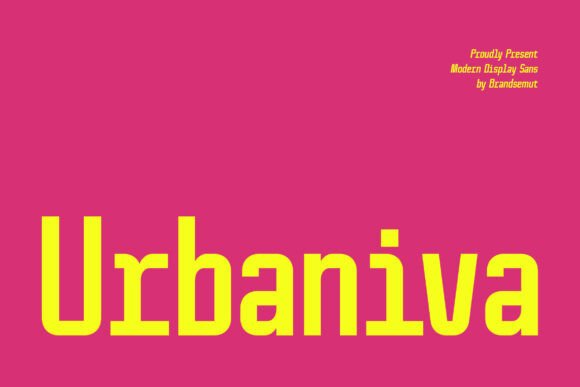
Urbaniva is a futuristic sans serif that doesn’t shout — it settles in. Think clean lines, balanced proportions, subtle curve tension at terminals, and generous x-heights that make even tiny text feel legible and intentional. It’s not cold or robotic; there’s warmth in its openness, a quiet friendliness in its spacing. As a display font, it thrives where attention matters most: logos, product names, invitation headlines, boutique tags, and packaging front panels. It’s the kind of typeface that makes handmade goods look thoughtfully designed — not just lovingly made.
I tested Urbaniva across real projects this season: lavender candle labels printed on removable vinyl, wedding welcome boards laser-cut from birch plywood, printable wall art for nursery bundles, and digital planner pages with soft watercolor backgrounds. Every time, it held its own — crisp at 12pt on a tiny gift tag, commanding at 96pt on a 16x20” print. Its light, regular, and bold weights gave me flexibility without visual whiplash. No need to jump to another family for contrast — Urbaniva’s internal rhythm does the work.
For physical products, readability is non-negotiable. On my Cricut Explore Air 2, Urbaniva cut cleanly at 8mm height on matte sticker paper — no jagged corners or lost details. The letterforms are generous enough to survive small-scale printing (like 6mm boutique tags), yet refined enough to shine on large-format signage. When I mocked up a set of holiday mug designs, the bold weight anchored “Cozy Season” beautifully beside hand-drawn holly sprigs — no competing with illustration, just supporting it.
What surprised me was how well Urbaniva paired with other voices. With a gentle script font like a relaxed brush script, it created instant hierarchy: “Evelyn & James” in Urbaniva bold, followed by “October 12, 2024” in delicate cursive. For planner inserts, I paired it with a simple, low-contrast serif — think Garamond or Lora — for body text, letting Urbaniva handle section headers and weekly focus quotes. Even with a bold display sans (like Montserrat Black), Urbaniva held space without clashing — its slightly softer terminals and even stroke contrast kept things harmonious.
It’s not built for long paragraphs — and that’s okay. Urbaniva shines in short, high-impact moments: shop name on a woven tote bag, scent name on a soap bar wrapper, “Thank You” on a folded thank-you card, or “Limited Edition” stamped on seasonal packaging. Its clarity makes it ideal for SVG files used in cutting machines, especially when layering text over textured backgrounds or distressed prints. Just avoid ultra-thin weights for small stickers — stick with Regular or Bold for anything under 10mm tall.
I also appreciate how thoughtfully it’s built for real-world use. The OTF files include standard ligatures (like “fi”, “fl”) that polish digital previews and PDF listings, and the character set covers Western European languages — essential when selling printable templates globally. Before uploading my next digital greeting card bundle to Etsy, I double-checked the commercial license — yes, Urbaniva permits use in both physical products and digital downloads, as long as end users aren’t reselling the font itself. That peace of mind matters when you’re bundling editable Canva templates or layered PSD mockups.
Seasonal work feels effortless with Urbaniva. For spring, I used its light weight with soft pastel gradients on printable garden-themed wall art. For fall, the bold weight grounded “Harvest Gatherings” on linen-textured invitation suites. Even farmhouse-style signs got an upgrade — swapping out overly rustic fonts for Urbaniva’s clean geometry gave them modern staying power without losing warmth. And yes, it works on fabric: I heat-pressed Urbaniva-bold onto cotton tees using basic iron-on vinyl, and the letters stayed sharp after three washes.
What truly makes Urbaniva special isn’t just how it looks — it’s how it behaves across your workflow. It imports smoothly into Canva, Silhouette Studio, and Affinity Designer. It renders crisply in PDF previews and social media banners. It scales without distortion in listing mockups. Most importantly, it helps your brand feel cohesive — whether someone sees your font on a sticker sheet, a digital planner cover, or the back of a hand-poured candle jar.
If you’re choosing a new sans serif for your shop — one that balances modernity with approachability, precision with personality — Urbaniva earns its place in your core design assets. It’s not flashy. It doesn’t try too hard. It simply gives your handmade work the quiet confidence it deserves.
- Use Urbaniva for: candle labels, greeting cards, wedding invitations, printable wall art, planner pages, boutique tags, mug designs, tote bags, seasonal packaging, and shop logos
- Avoid using its lightest weight for small stickers or fine-detail cuts — opt for Regular or Bold instead
- Pair it with a gentle script for invitations, a classic serif for editorial-style printables, or a bold sans for high-energy digital bundles
- Always verify commercial licensing before including Urbaniva in editable templates, SVG files, or physical merchandise
- Test spacing and size early — Urbaniva’s generous metrics mean tighter tracking often works better than default settings